
The Cost Of Illusion and False Enlightenment
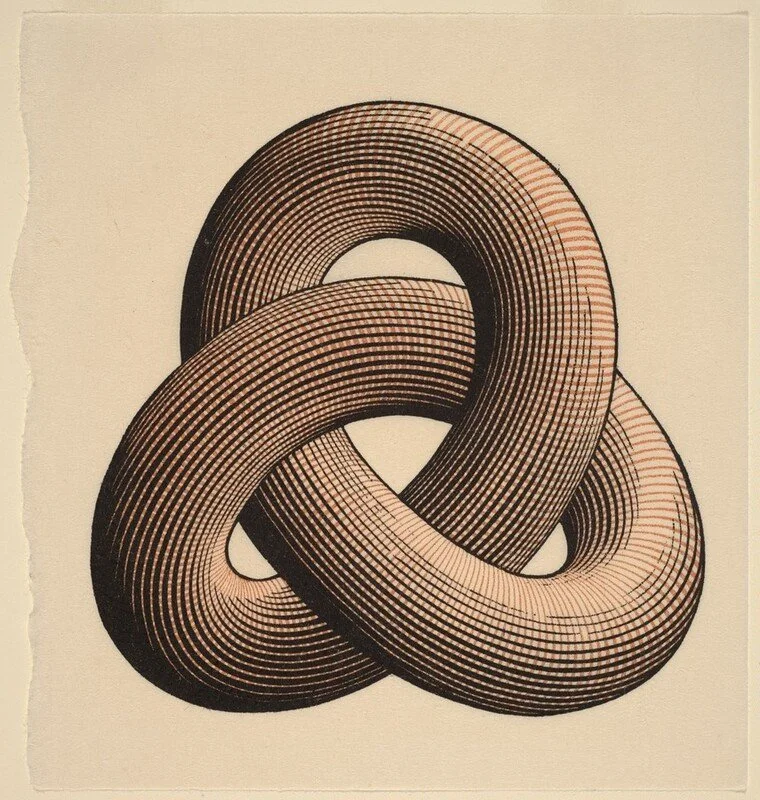
Knots, (1965) M.C. Escher
There is something deeply seductive about the idea of enlightenment. The promise that one day, everything will click into place—that confusion will dissolve, suffering will vanish, and we will finally understand. It offers a sense of completion, of arrival, of being done with the restless searching that defines so much of human experience. But what we often chase is not enlightenment itself, but an illusion of it.
False enlightenment feels convincing because it mimics clarity. It often arrives as a sudden realisation or a powerful emotional shift, something that feels transformative and absolute. It comes with strong beliefs, rigid certainty, and the comforting sense that the search is over. It tells us: “You’ve arrived. You know now.” And in a world full of uncertainty, that message is incredibly appealing.
But real understanding rarely announces itself with such finality. It is quieter, more subtle, and often more unsettling. It does not remove all questions—it deepens them. It does not eliminate uncertainty—it teaches us how to live with it. True insight tends to humble rather than elevate. It softens the need to be right and opens space for curiosity, nuance, and change.
Art has always held that peculiar power: it can illuminate, but it can just as easily simulate illumination. The experience of encountering art—especially when it feels profound or intellectually charged—often creates a sense of insight that may not withstand scrutiny. There we go again with the illusion of false enlightenment: a moment where emotional resonance or aesthetic complexity is mistaken for genuine understanding. In such cases, art does not clarify truth but wraps ambiguity in a convincing form, allowing the audience to feel as though they have grasped something meaningful without actually engaging in the difficult work of interpretation or critical thought.
This dynamic is not necessarily a failure of art itself, but rather a reflection of how it is received.
Art invites projection; viewers bring their own assumptions, desires, and intellectual insecurities into the experience. When confronted with something obscure or symbolically dense, it can be easier to accept the feeling of depth than to question whether that depth exists. The language surrounding art—often abstract, conceptual, or deliberately opaque—can reinforce this effect, creating a cultural environment where appearing to understand becomes more important than actually understanding.
The illusion becomes even more pronounced in contexts where art is tied to status or intellectual identity. In galleries, academic discourse, or curated online spaces, the pressure to “get it” can subtly discourage honest confusion. Instead of admitting uncertainty, audiences may adopt interpretations that sound sophisticated but remain unexamined. In this way, art can become a mirror not of truth, but of social performance—a place where the appearance of insight substitutes for insight itself.
At the same time, artists themselves sometimes engage deliberately with this phenomenon. By creating works that hover between meaning and obscurity which they can provoke viewers into confronting their own interpretive habits. Is the work truly profound, or does it merely trigger the expectation of profundity? This tension can be productive. When recognised, it destabilises passive consumption and demands a more active, self-aware form of engagement.
Importantly, false enlightenment is not always empty. Even when the initial sense of understanding is illusory, it can act as a gateway. The feeling of “almost knowing” may encourage deeper questioning, prompting viewers to revisit the work, research its context, or reflect more carefully on their own reactions. In this sense, illusion can precede insight—it can be the spark that leads to a more rigorous encounter with meaning.
Ultimately, the relationship between art and false enlightenment reveals something fundamental about human perception. We are drawn to coherence, to patterns, to the suggestion of hidden truths. Art leverages this tendency, sometimes clarifying it, sometimes exploiting it. The challenge for the viewer is not to reject the emotional or intuitive response, but to interrogate it: to ask where it comes from, what sustains it, and whether it points beyond itself. In doing so, one moves from the comfort of apparent understanding toward the more demanding, but far more rewarding, pursuit of genuine insight.
There is also a certain honesty in real insight. It acknowledges how much we do not know. It accepts that perception is limited, shaped by context, experience, and perspective. Rather than elevating us above others, it often brings a sense of connection—a recognition that everyone is navigating their own version of reality, with their own assumptions and illusions.
Perhaps enlightenment is not something we achieve once and for all. Perhaps it is not a state we can permanently hold, nor a label we can accurately claim. Perhaps it is something we practice—a continuous unfolding rather than a final destination. A way of relating to experience with openness, awareness, and humility.
And perhaps the first step toward it is not gaining something new, but letting go of something false—the illusion of having already arrived. Because the moment we admit that we might still be mistaken, that there is more to see, more to understand, is the moment we become truly available to something deeper than certainty.
In that sense, real enlightenment may feel less like standing at the top of a mountain, and more like walking without end—awake, attentive, and willing to be changed by what we encounter along the way.
